

American Beachgrass
Ammophila breviligulata
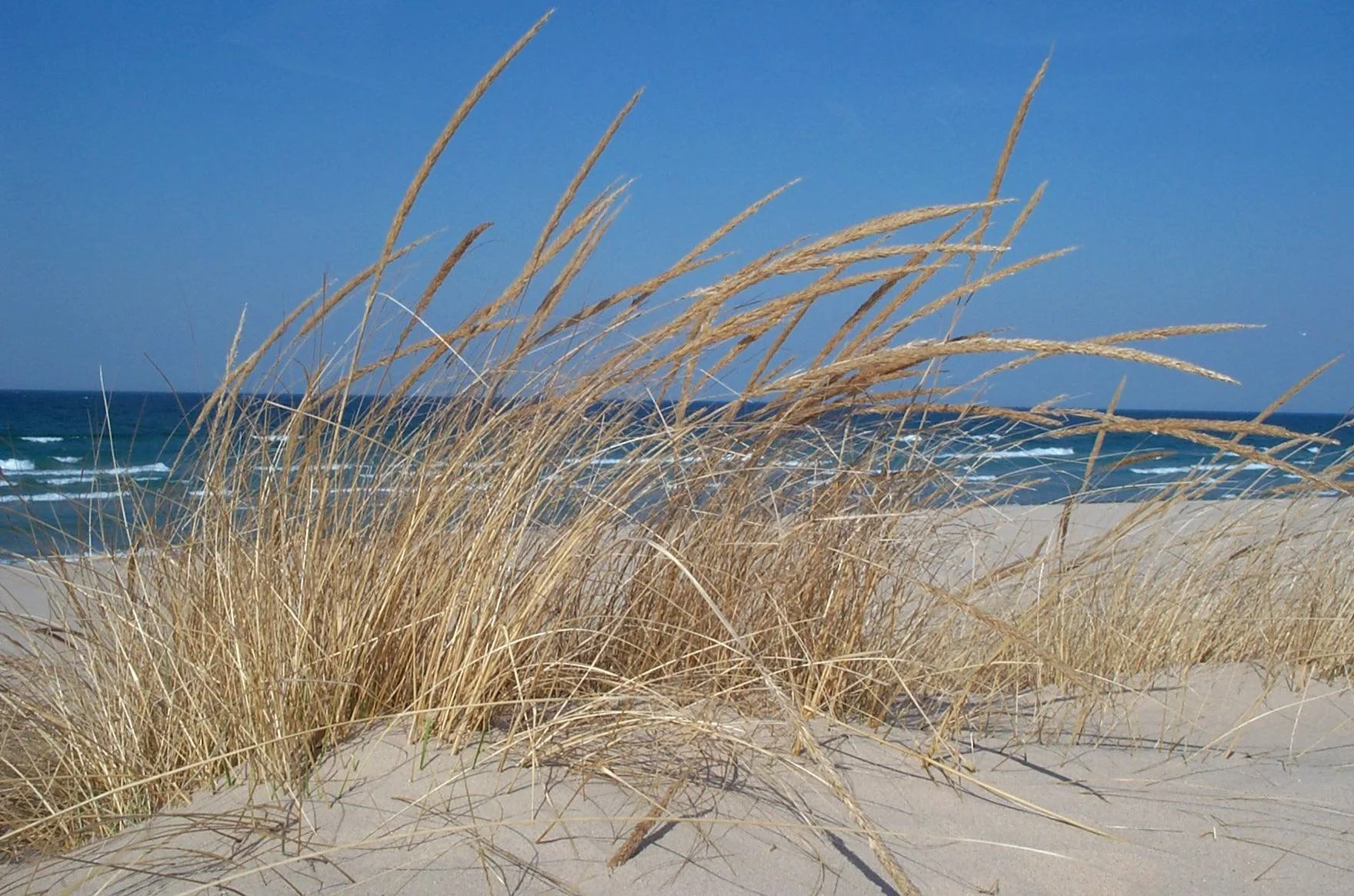
American beachgrass (Ammophila breviligulata) is a hardy perennial plant native to the coastal areas of the mid-Atlantic and Great Lakes regions. It prefers growing in sandy well drained soils and is one of the best plants suited to stabilize a dune or other sandy areas due to the plants network of rhizomes (or course root system) that grow beneath the sand. Typically, 2 or 3 ft tall, with long narrow leaves this plant grows in bunches which can serve a natural ‘re-bar’ stabilizing the sand from both above and below.
Living along the coastal areas of Lake Michigan can be quite beautiful, but it also can come with challenges because much of the eastern shore is an actively eroding coastline made up from sediments that have been deposited by the wind. With poor soil composition and often sunny exposure it is a challenge to get any kind of plants to take hold. Beachgrass is native to this challenging environment and has adapted to thrive in full sun, low moisture environments. Once beachgrass has been established it in an area it can serve as a stabilizing mechanism for the sand, stopping erosion and potentially providing the foundation to allow other plants to grow in the area.
Why plant Beachgrass?
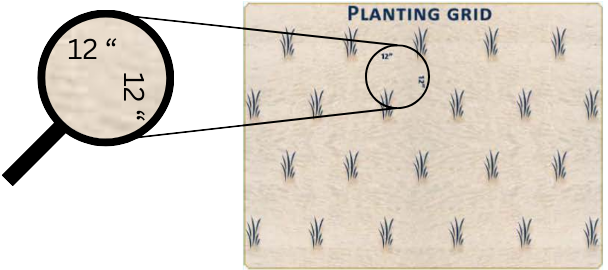
Set up planting grid with stakes on each row end; tie with strings crossing the planting area to make a grid
Moisten sand with sprinkler to mimic a soaking rain – this will keep the holes from backfilling
Keep plant roots covered from wind/sun drying while conducting your planting –this has proven to be the greatest determining factor on plant survival!
Open a small hole using a tool like a spade shovel, tree planting bar, or hand trowel – use the heel to dig! (See image)
Insert 2 culms, using a tool to keep sand from falling into hole. Fill sand around base of plants.
Tips for a successful planting:
Compact soil around plant by tamping with foot or place the tool in the ground 2-3 inches away, pull handle away from plants to compact soil toward plant -air gaps in the planting hole lower survival rates.

What to expect if you order from the Conservation District
Culms may be growing in clumps of anywhere from 1 to 8. We keep them clumped together to preserve moisture; upon planting, keep them together for a more natural look, or pull them apart into individual culms to achieve the following coverage.
Recommended spacing of:
24” x 24” for level, stable areas
18” x 18” for some slope or erosive areas
12” x 12” for steep slopes or highly erosive areas.
For better survival and sand collection, place 2-3 culms to each hole:
100 culms will cover about 50sq ft at 12” spacing with 2 culms per hole.
500 culms will cover about 250sq ft at 12” spacing with 2 culms per hole.

Looking to buy beachgrass for your dune or shoreline project? We offer bundles for sale in the spring and fall. Order online through our shop or contact our office for details.
Beachgrass comes in bundles of either approximately 100 or 500 culms (stems). Each culm will have at least 1 – 3 leaves.
Beachgrass FAQ
-
A planting done at the 18” x 18” spacing will often fill in completely with beachgrass within 3 years.
-
The district’s beachgrass is native stock and is inspected annually by the Michigan Department of Agriculture Pesticide & Plant Division. Our staff also inspects plants during harvest to ensure we are providing clean plant specimens.
-
Beachgrass produces seed in a spike-like panicle (cluster) about 10 inches long, usually visible in late July or August. We do not recommend using the seed because when seeds are shed in the fall, they dry out easily or are sandblasted, buried, or blown away. Planting culms gives the best results for stabilization.
-
Planting 1-3 stems per hole is recommended One stem with three leaves is one plant or a culm. Sometimes, the culms will come clumped with several others. These culms can be broken down into single culms so that the plants will cover a bigger area. When we harvest, we will count out culms for bundles of 100, but bundles of 500 are close estimates based on volume of the bundle size and culms are not individually counted.
-
Roots usually are not evident, but will develop from basal nodes after planting. Each culm, therefore, must have a small, white node at the base, from which the roots and buds grow.
-
Culms should be kept cool, moist, and planted as soon as possible. The basal portion, where new growth appears, must be protected from drying out. When you purchase your plants they are hand packaged in bundles of approximately 100 or 500 plants or culms. The basal portion is covered with wet moss or shredded paper and wrapped in nursery paper. If planting cannot be completed immediately, store in a cool, shaded place (or refrigerator), keep out of the wind and keep the base of the plants moist. This is acceptable for a few days, but no more than a week. If plants can't be planted within a week, the beachgrass can be healed in temporarily by placing it in a trench dug in the sand, be sure to cover and water the beachgrass well.

MLCD crew harvesting beachgrass